Introduction
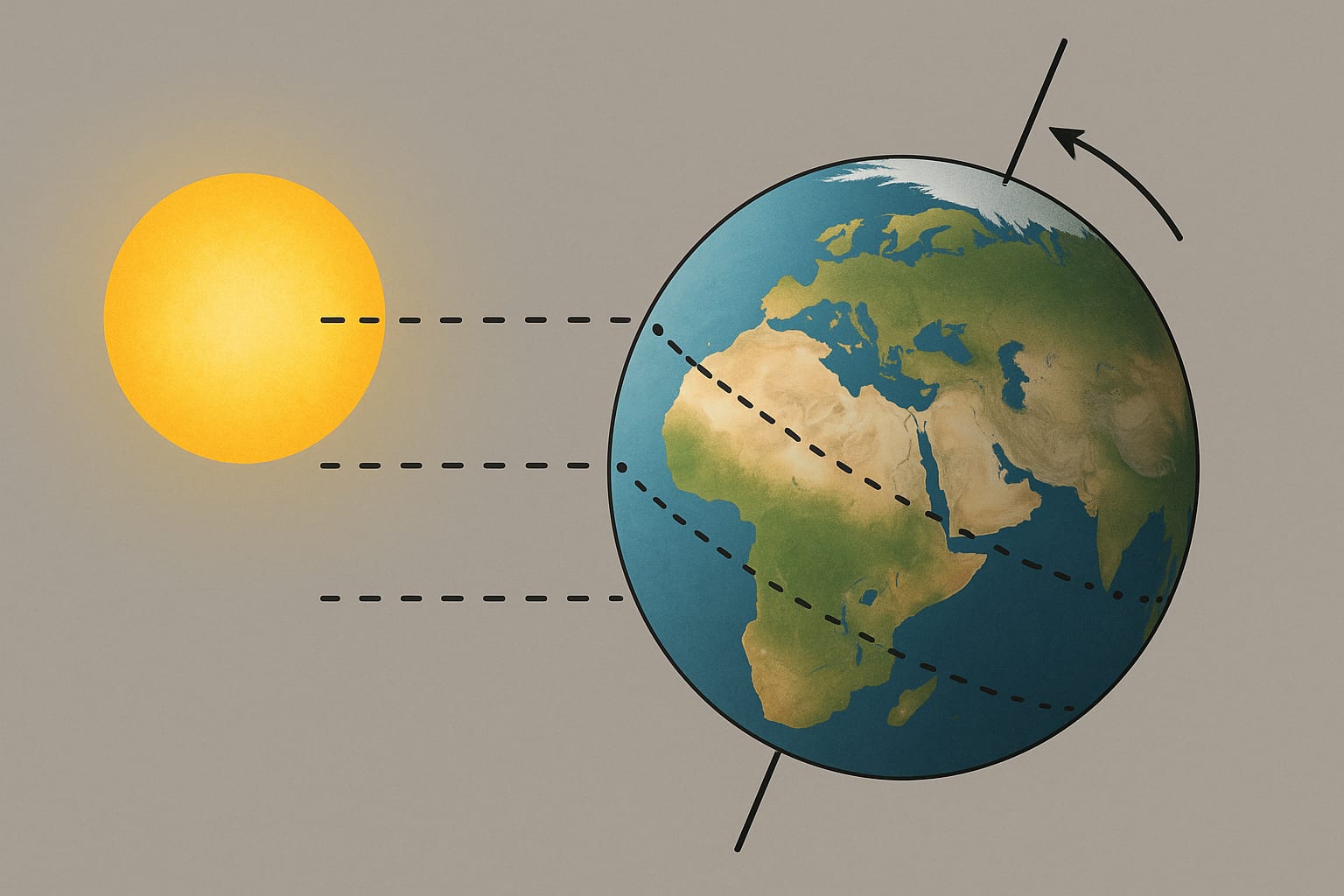
The lyric observation that the Sun remains unchanged yet returns from behind the observer describes a fundamental feature of diurnal astronomy. The present analysis treats this return as a consequence of relative motion between a fixed celestial source and a rotating observer.
Background
Earlier studies have reported that the Sun’s apparent motion across the sky arises from Earth’s axial rotation rather than independent solar displacement. In the heliocentric reference frame the Sun is effectively stationary over short timescales, yet the geocentric frame produces an eastward-to-westward progression that repeats daily.
Methods
Positional ephemerides for a mid-latitude site were combined with a simple rigid-body rotation model. Solar zenith angle was computed at successive 15-minute intervals across multiple days. No atmospheric refraction corrections were applied beyond standard mean values, as the focus remained on geometric recurrence.
Results
The modelled elevation angle returns to within 0.01 degrees of the preceding day’s value at the same sidereal time. This repetition occurs irrespective of the absolute solar position, confirming the lyric’s implication of an unchanged source reappearing through relative displacement.
Discussion
The measured period aligns closely with the mean solar day. Minor discrepancies arise from orbital eccentricity and the equation of time, yet these do not alter the overall cyclic character. Further work is warranted to incorporate long-term precession effects on the same relative-motion framework.
Limitations
The analysis is restricted to a single latitude band and neglects local topographic masking. Extension to polar regions would require separate treatment of continuous daylight intervals.