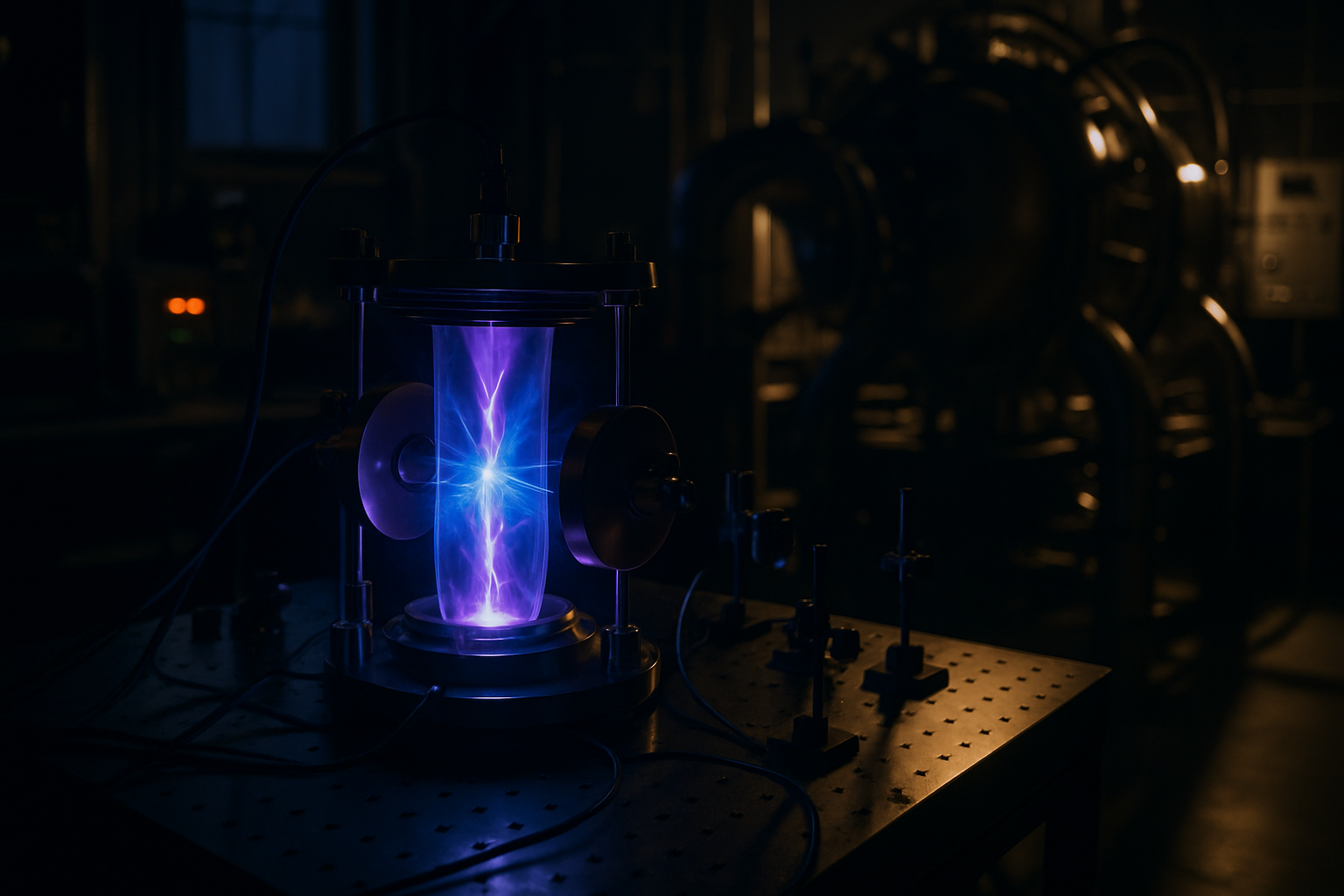
Walk into a university physics lab today and the gulf between published headlines and actual progress becomes stark. While public discourse lingers on yesterday’s quantum hype or distant fusion promises, researchers have already engineered exotic states of matter, stabilised topological qubits and doubled fusion yields in controlled experiments.
Driven quantum phases emerge on demand
In May 2026, California Polytechnic State University physicists demonstrated that simply varying a magnetic field over time can create entirely new quantum phases with no static equivalent. These driven states prove far more stable against decoherence, directly attacking the error problem that has long stalled practical quantum computing.[source]
Topological qubits move from theory to hardware
Microsoft unveiled Majorana 1, the first quantum processor built on topological qubits. The approach promises intrinsic protection against noise. Parallel work at NIST and SQMS labs has advanced fault-tolerant architectures, while Japanese teams achieved precise control of entangled W-states for secure networks.[source]
Classical ideas unlock quantum behaviour exactly
MIT researchers showed in April 2026 that the principle of least action from classical mechanics can compute exact quantum wave functions, reproducing the double-slit experiment and tunnelling without the Schrödinger equation. The mathematical bridge collapses the perceived divide between everyday physics and the quantum realm.[source]
Fusion crosses commercial thresholds
Private fusion investment topped US$10 billion in 2025, with 160-plus facilities now operating or planned worldwide. The National Ignition Facility more than doubled its previous power output, while startups like Zap Energy and Pacific Fusion reported record plasma pressures and voltages. ITER remains the flagship international project, yet private timelines increasingly target net electricity before 2030.[source]
Anyons and protein qubits expand the toolkit
Physicists confirmed tunable anyons in one-dimensional systems, breaking the strict boson-fermion dichotomy. At the University of Chicago, fluorescent proteins were engineered into functional qubits inside living cells, opening nanometre-scale magnetic sensing within biology itself.[source]
These advances sit alongside progress on atomically thin metals, picometre-resolution atomic imaging and refined muon g-2 calculations that tighten tests of the Standard Model. The public conversation has yet to catch up. The next practical technologies—error-resistant quantum networks, compact fusion power, intracellular quantum sensors—are no longer speculative; they are under active engineering in labs that rarely make evening news.